NeuralPath AI - Investor Data Room

Date
June 2026
Role
Product Designer & Developer
Company
Neutral AI
RAG Architecture · AI Engineering · Full Stack Development
Key Outcome
How a RAG pipeline turned a folder of PDFs into a conversational data room
A solo seven-day build that turned a folder of PDFs into a conversational data room — investors ask questions, get cited answers instantly, no founder required.
Background
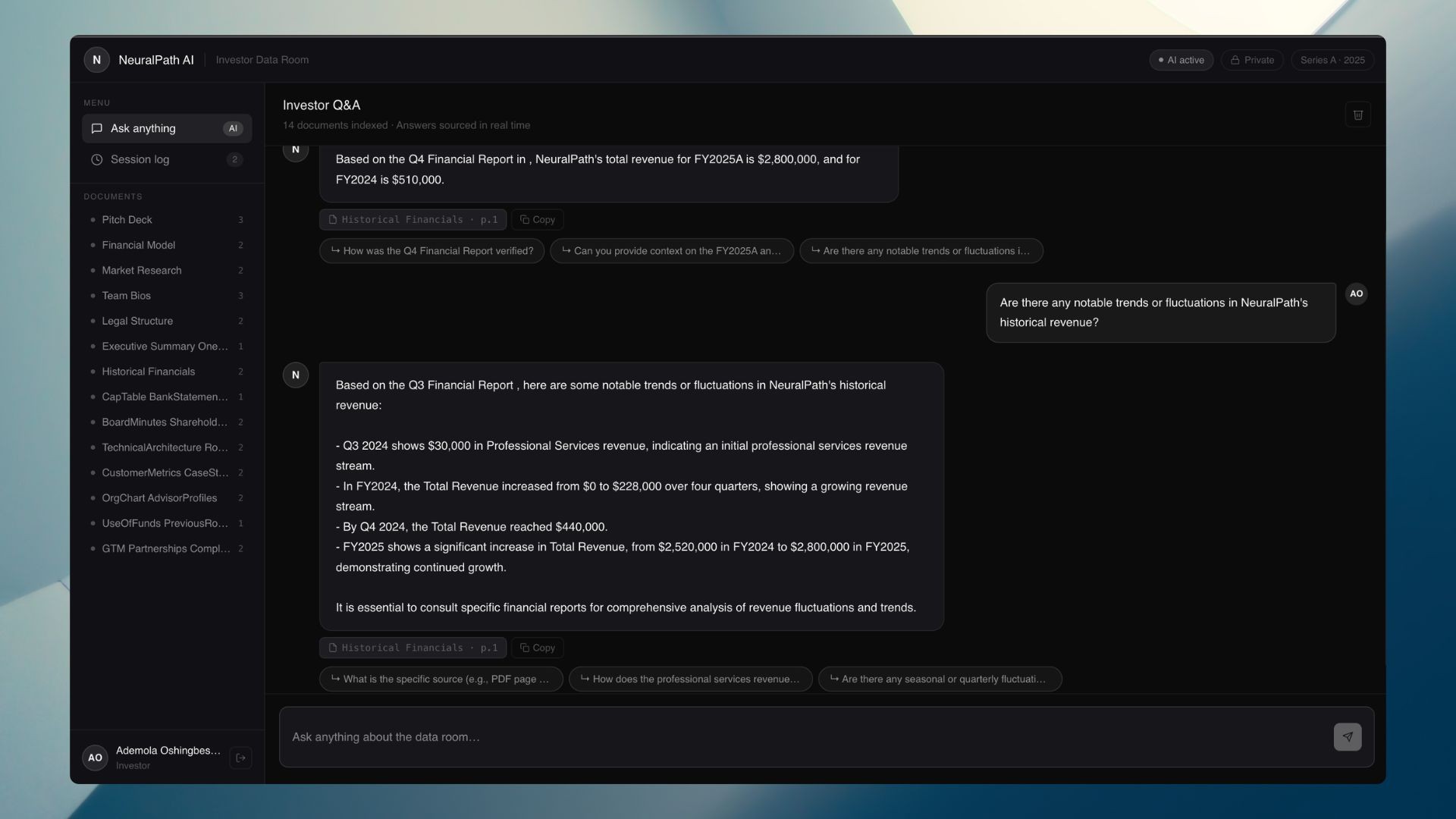
Most data rooms show documents. NeuralPath AI has a conversation with them.
NeuralPath AI is a private, AI-powered investor data room that lets founders share curated company documents with investors and lets investors ask natural-language questions and receive accurate, cited, streaming answers without the founder needing to be present.
It was built entirely solo in one week, using AI-assisted development with Claude Code. The product replaces the traditional static data room, a folder of PDFs on Google Drive or Notion, with an intelligent conversational interface backed by a full Retrieval-Augmented Generation (RAG) pipeline. Designed, engineered, and deployed without a team.
The Problem
Fundraising is repetitive, slow, and entirely dependent on the founder being available to answer the same questions dozens of times.
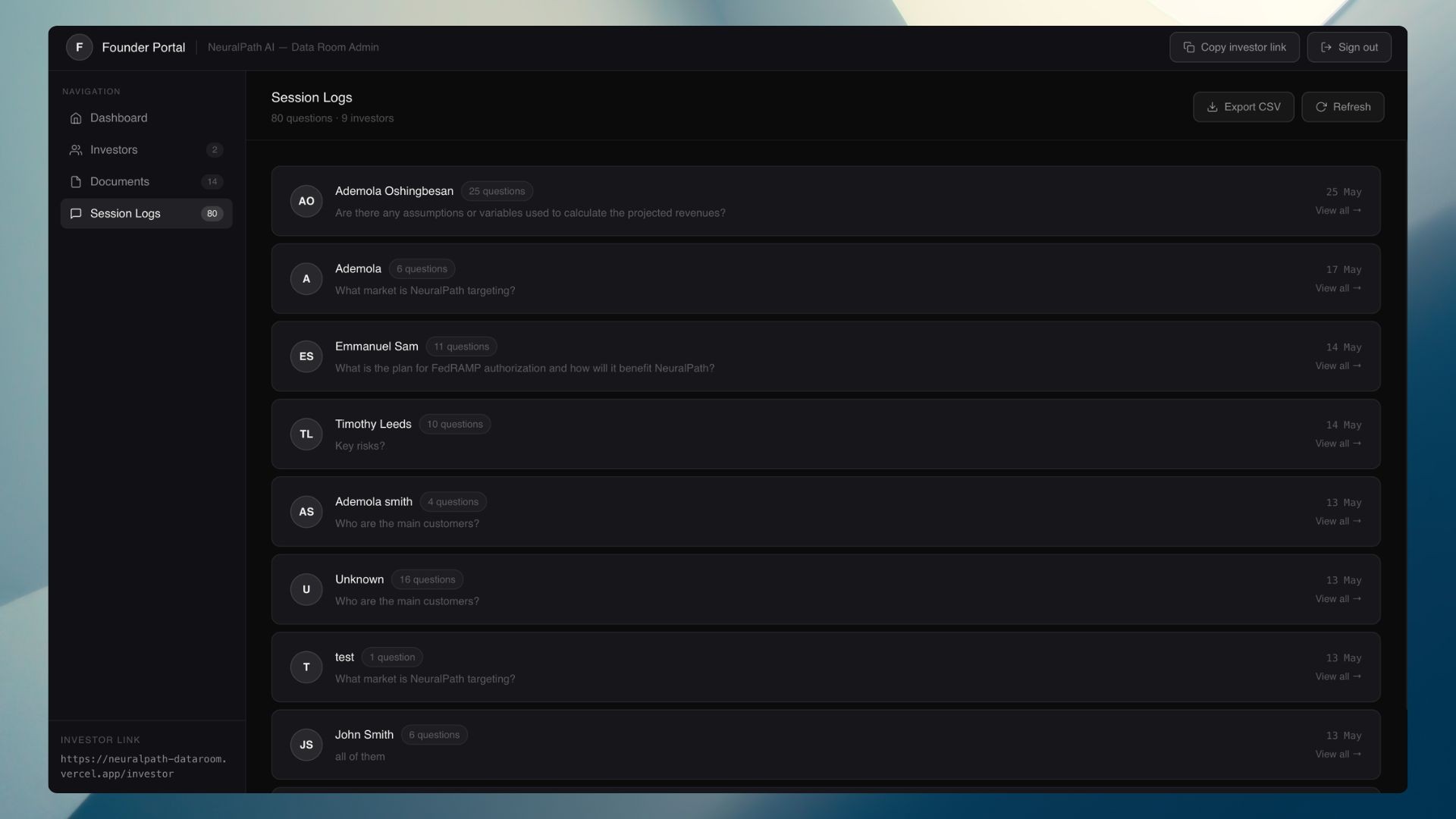
The average fundraising process involves 20–30 investor conversations. Each investor works through the same documents at their own pace and asks largely the same 40–80 due diligence questions. Answering each question takes 5–20 minutes: locating the relevant section of a document, drafting a clear reply, citing the source correctly. For a founder also running a company, this is weeks of avoidable work.
The deeper problem is momentum. Investor interest is time-sensitive. A question that sits unanswered for 24–48 hours can cool a conversation that was moving. Every delay in the diligence process is a risk to the raise.
"An investor can ask 'What is the LTV:CAC ratio?' and get a precise, streamed answer drawn from the financial model, cited to the exact document, in under three seconds — without the founder being online."
The Solution
A full RAG pipeline from question to cited answer designed to be structurally incapable of hallucinating.
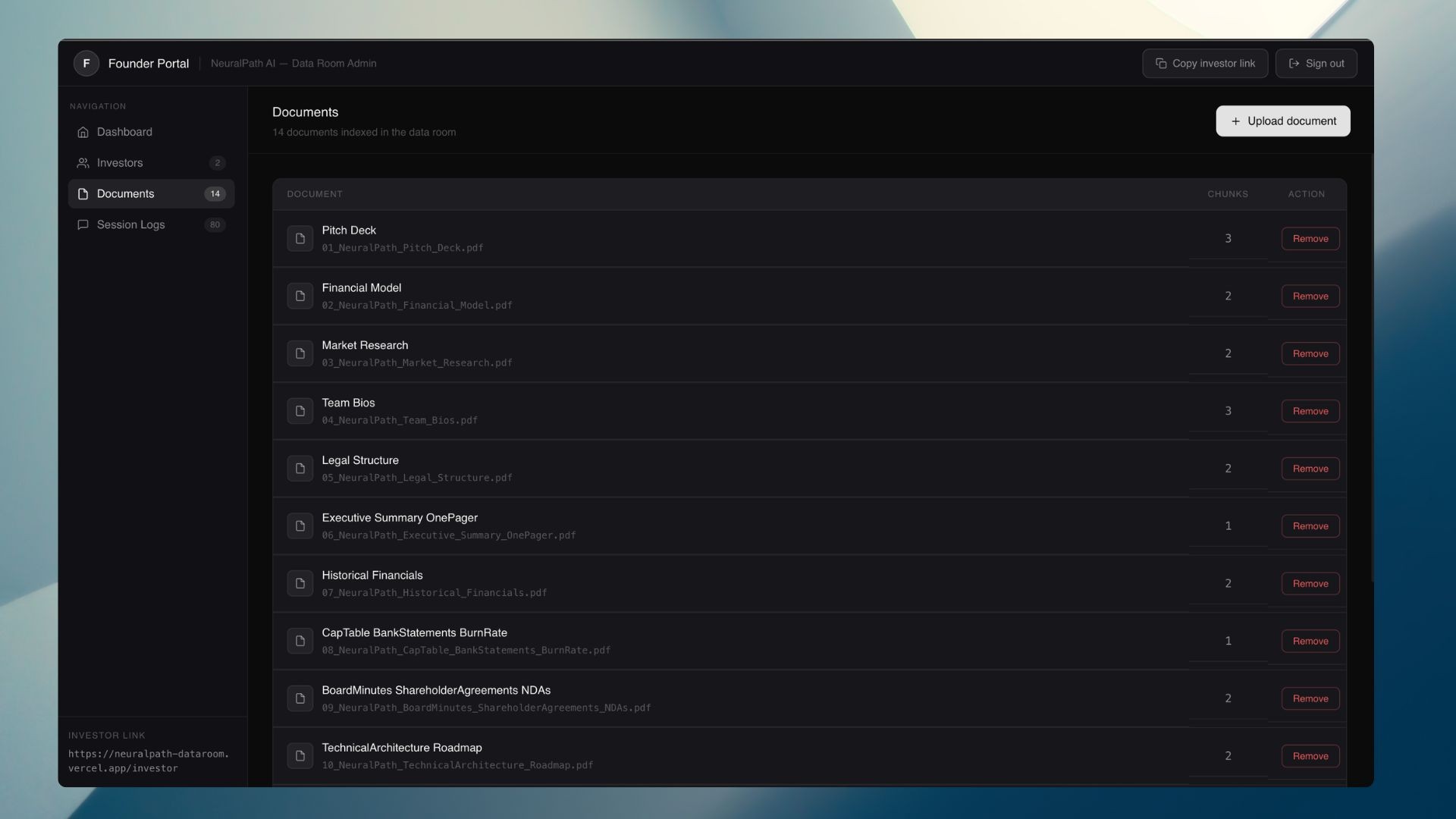
Documents are pre-processed into overlapping chunks, embedded into 384-dimensional vectors using fastembed (all-MiniLM-L6-v2 ONNX runtime), and stored in Supabase pgvector. At query time, the question is embedded and matched via cosine similarity. The top five most relevant chunks are passed to Groq as the only context, making it structurally impossible for the AI to introduce facts not present in the uploaded documents.
The pipeline:
Question → vector: Investor's question embedded into a 384-dim vector via fastembed ONNX runtime
Vector search: Cosine similarity search in Supabase pgvector — returns top 5 most relevant document chunks
Grounded generation: Groq LLM synthesises a cited answer from retrieved chunks only; no external knowledge injected
Streaming + logging: Answer delivered as SSE token stream; full Q&A stored in Supabase per investor session
Key engineering decisions
Constraint 01 — Memory limit: 512 MB → solved with ONNX
Original sentence-transformers consumed ~1.5 GB on model load, 3x Render's free-tier limit. Switching to fastembed (ONNX runtime) dropped peak memory to ~150 MB with bitwise-identical vectors.
Constraint 02 — Shared password → per-investor token model
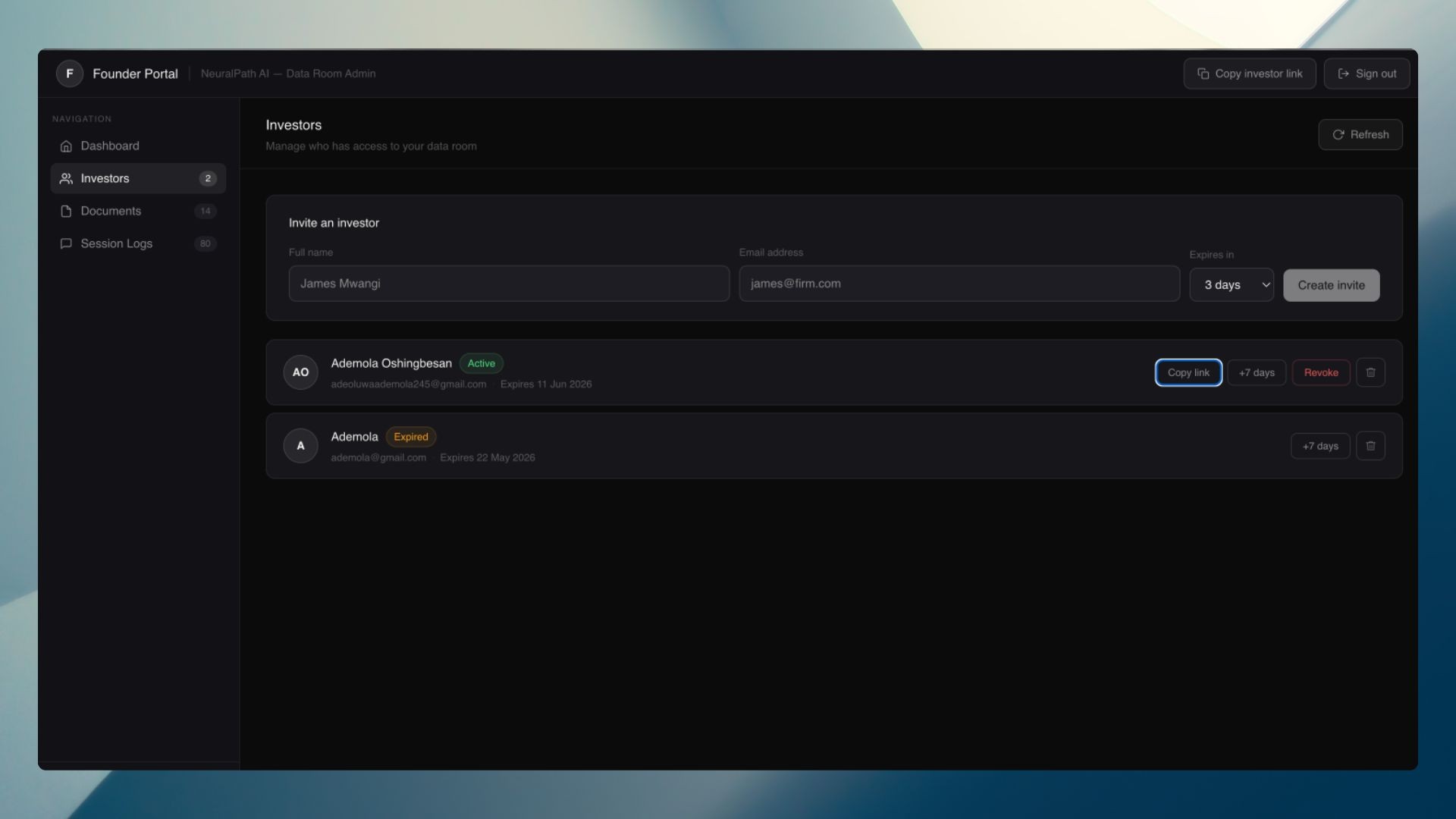
Access control rebuilt from a shared password to a Google Docs-style token system. Each investor gets a unique, named invite link. The founder can revoke any investor instantly locked out on the next page load.
Constraint 03 — Hallucination → grounded generation only
The model only receives the top 5 retrieved document chunks as context; it has no access to any external knowledge. It is architecturally impossible to answer outside the uploaded documents.
Constraint 04 — Latency → Groq streaming
Groq's inference speed combined with SSE streaming produces answers that begin appearing in under one second — significantly faster than standard OpenAI completions.
Outcomes & Impact
Full-stack RAG application in production — solo, in one week.
NeuralPath AI demonstrates that a technically complex AI product, one involving vector databases, embedding pipelines, streaming LLM responses, and multi-tenant access control, can be designed, built, and deployed by one person in a week. The build validated both the technical architecture and the product thesis: investors interact with it as naturally as a knowledgeable colleague, and founders gain visibility into diligence that a static data room never provides.
Reflections & What Comes Next
What building this in a week revealed about AI-assisted development.
The most technically demanding part of the build was not the RAG pipeline itself; it was the production constraints. The memory issue on day three took nearly a full day to diagnose and solve, and it was the kind of problem that would have been easy to miss until a critical demo failed. The lesson: deploy early and hit the infrastructure constraints while you still have time to fix them.
Using Claude Code throughout the build changed how I thought about solo development. Not because it wrote the code for me—it didn't—but because it compressed the research loop. Finding the fastembed ONNX solution and understanding pgvector's cosine similarity syntax and debugging the SSE streaming implementation took tasks that would have taken hours of Stack Overflow and documentation reading in minutes. The week would have been two or three without it.
Check Out the Live Product