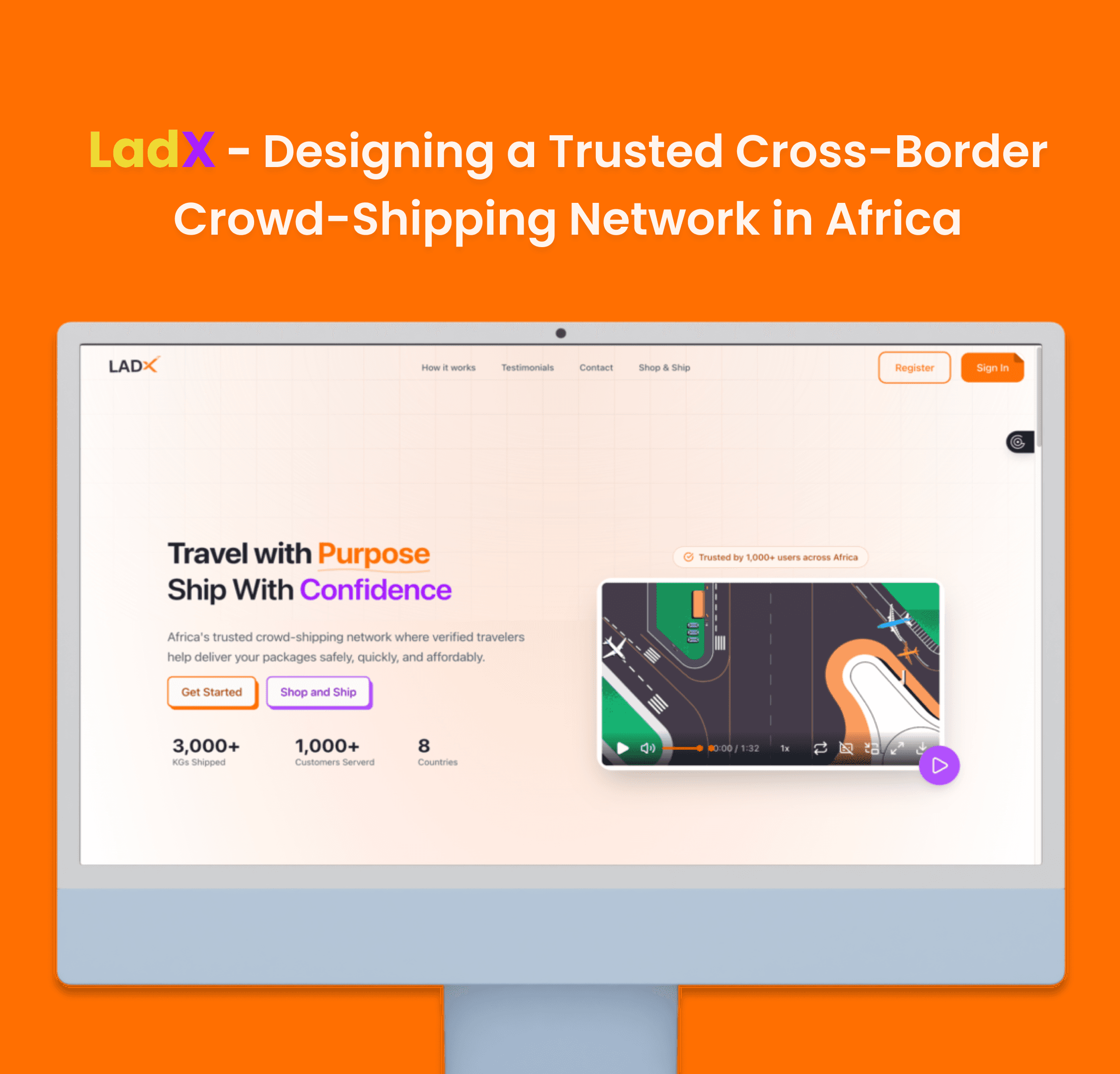
LadX
Date
March – August 2025
Role
First Product Designer (Solo role)
Company
LadX
Product strategy · UX design · Information architecture · MVP delivery
Key Outcome
How the MVP improved operations and allowed the marketplace to start scaling
After launching the MVP, manual coordination was replaced with a self-serve marketplace where travelers and senders could interact directly. The team gained real-time visibility into routes and shipment demand, reducing back-and-forth communication. At the same time, the platform began generating structured marketplace data, providing clearer insight into activity and supporting future product decisions.
Background
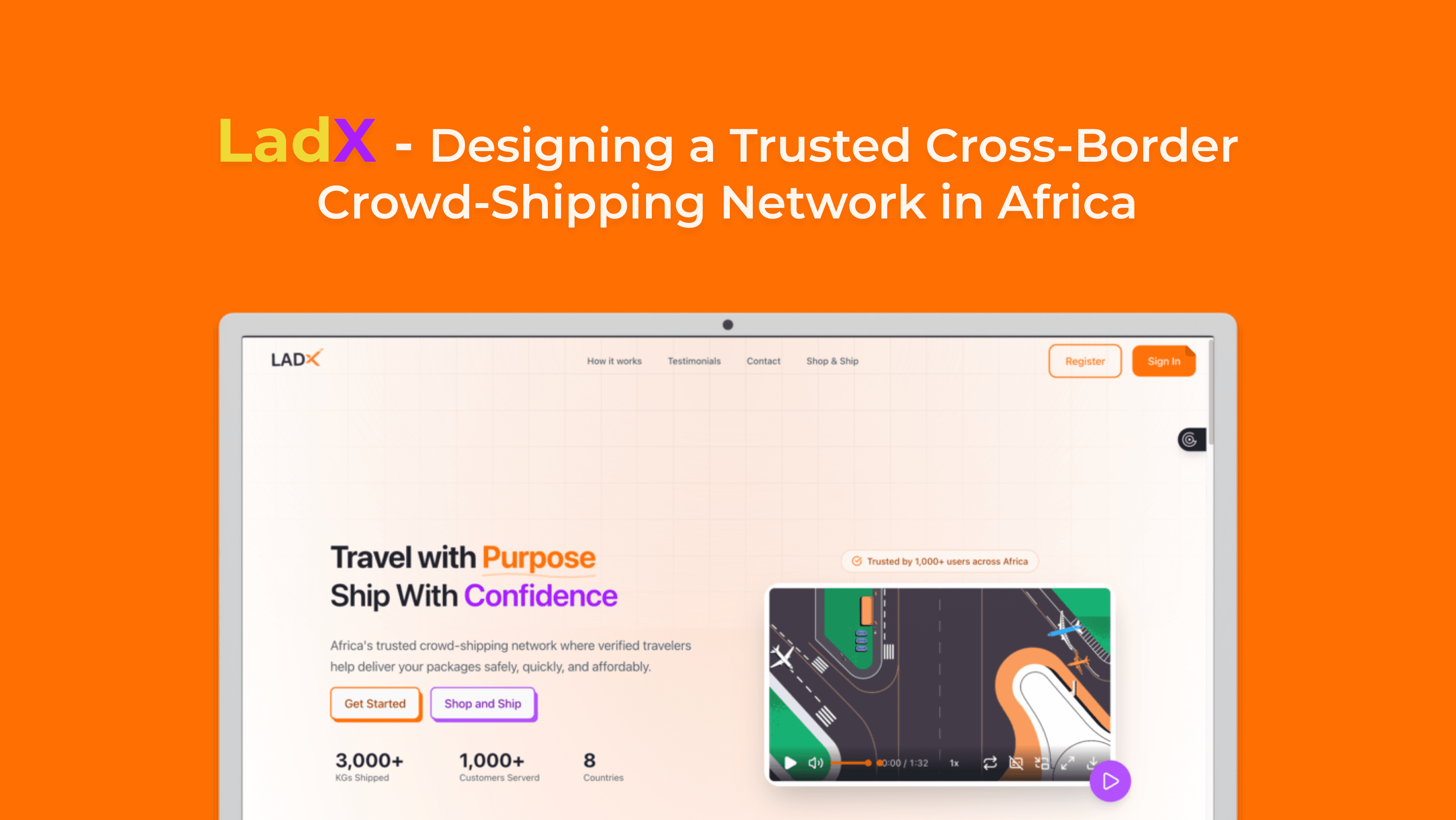
LadX is an early-stage startup building a trusted crowd-shipping network across Africa, connecting travelers with spare luggage capacity to senders who need to move packages across borders quickly and affordably.
The idea builds on an existing behavior people already rely on asking friends, family, or informal networks to carry goods between cities and countries and formalizes it into a structured digital marketplace.
I joined LadX as the first Product Designer to design and deliver the initial MVP web application. The goal was to transition the business from a mix of WhatsApp coordination and Google Form submissions into a centralized product capable of supporting real marketplace interactions.
Product Context
LadX operates as a peer-to-peer logistics network, enabling travelers with unused luggage capacity to transport packages along routes they were already planning to take.
Think:
Airbnb for luggage space.
Before building the MVP, LadX experimented with a lightweight operational model using:
WhatsApp → communication and negotiation
Google Forms → collecting shipment or travel details
Manual spreadsheets → founders attempting to reconcile requests
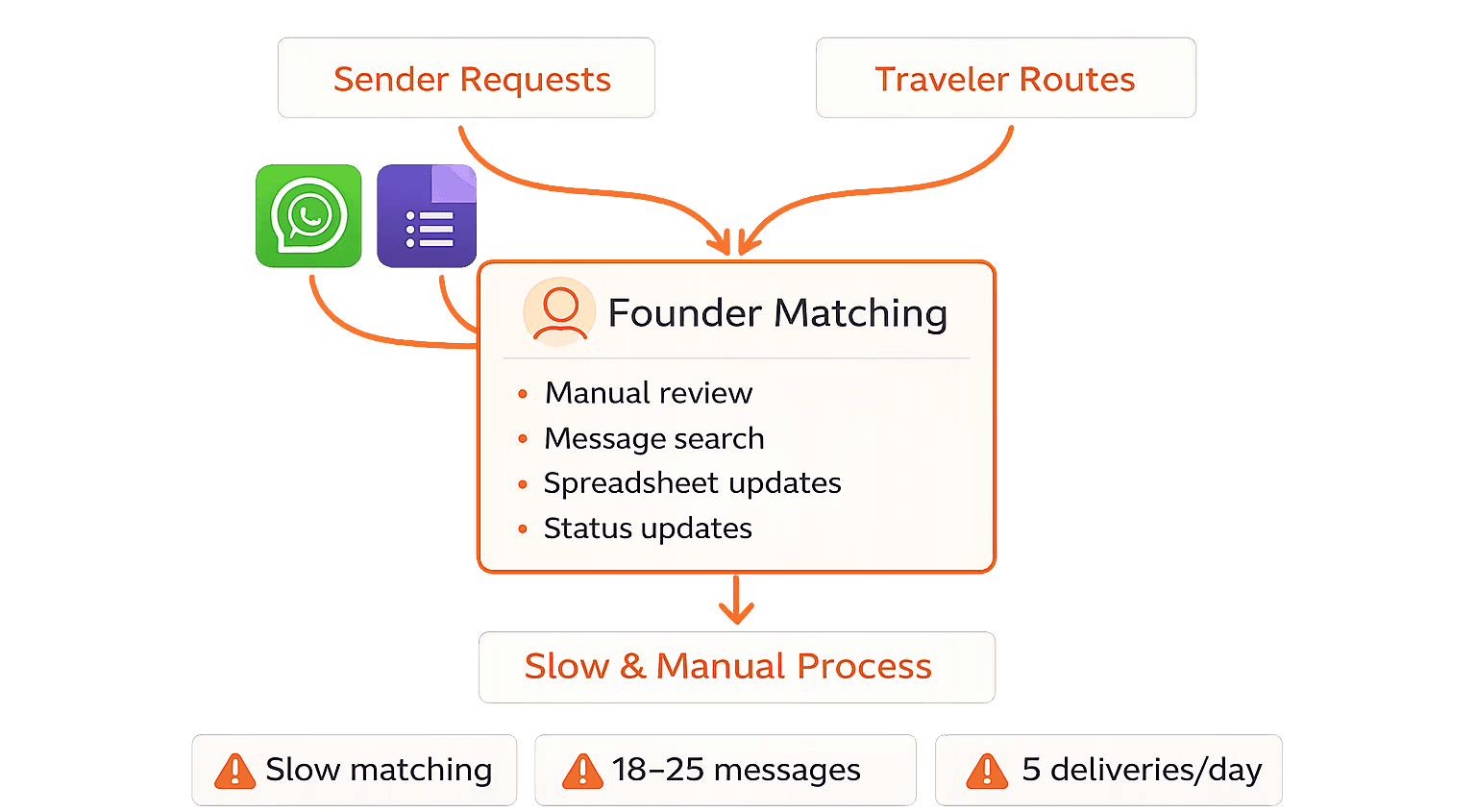
What a typical transaction looked like in the Pre-MVP Workflow:
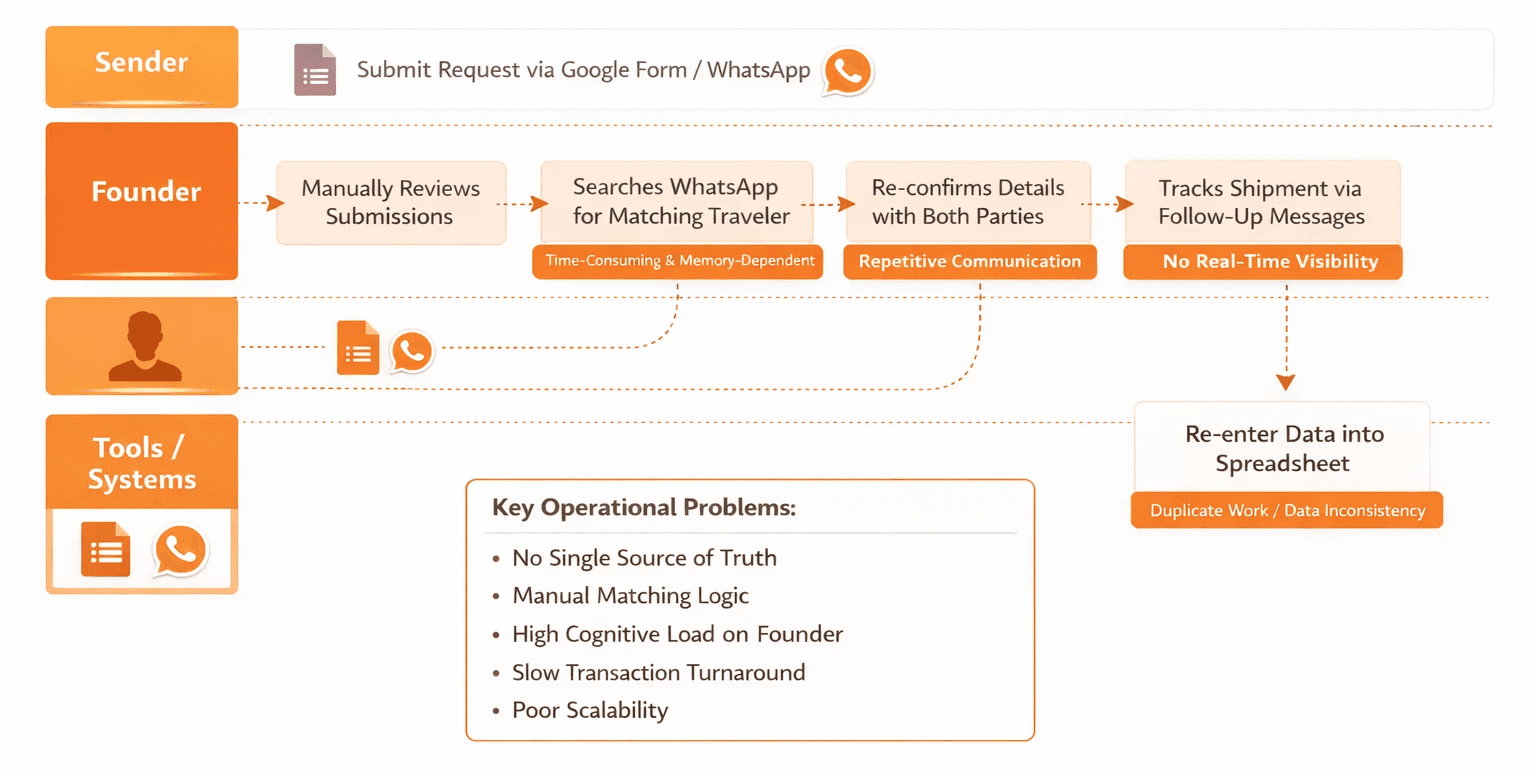
This hybrid approach helped validate early demand but quickly revealed structural limitations but Instead of reducing effort, the tools created duplicate work across systems.
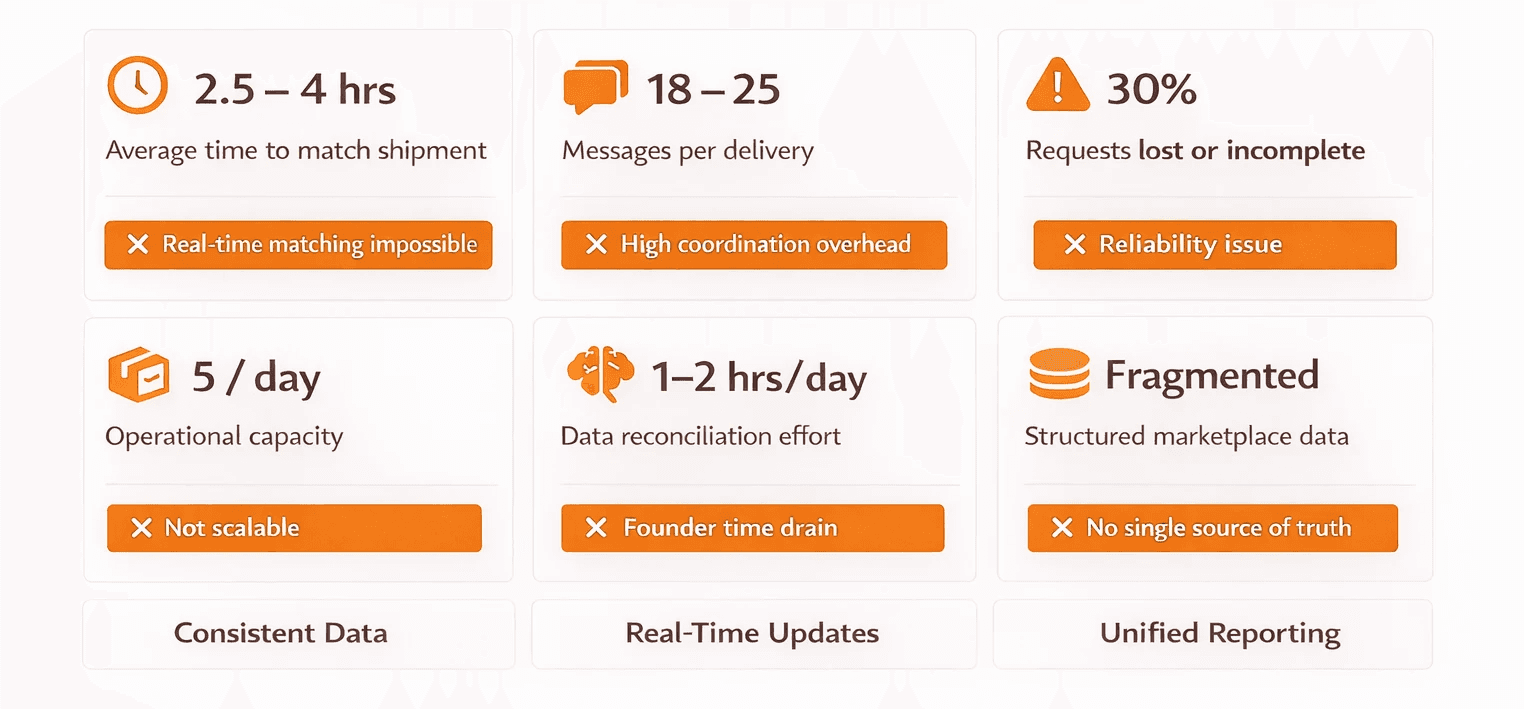
Quantified Problems (Operational Audit)
We reviewed several weeks of activity to understand where time and reliability were breaking down.
The Problem
Manual coordination across disconnected tools prevented LadX from operating as a real Marketplace.
What initially appeared to be a lightweight setup using WhatsApp for communication and Google Forms for intake began to break down as activity increased. While requests were captured, they did not become part of a live system. Each successful match required founders to manually review submissions, search message histories for available travelers, and reconnect both parties through repeated back-and-forth conversations.
Without a real-time view of supply and demand, matching relied on memory rather than data, creating a hard ceiling on daily capacity and leading to an inconsistent user experience. The fragmented workflow also produced unreliable records, limiting the team’s ability to learn from activity or make informed product decisions.
What existed was a semi-structured process not yet a scalable marketplace.
The Solution
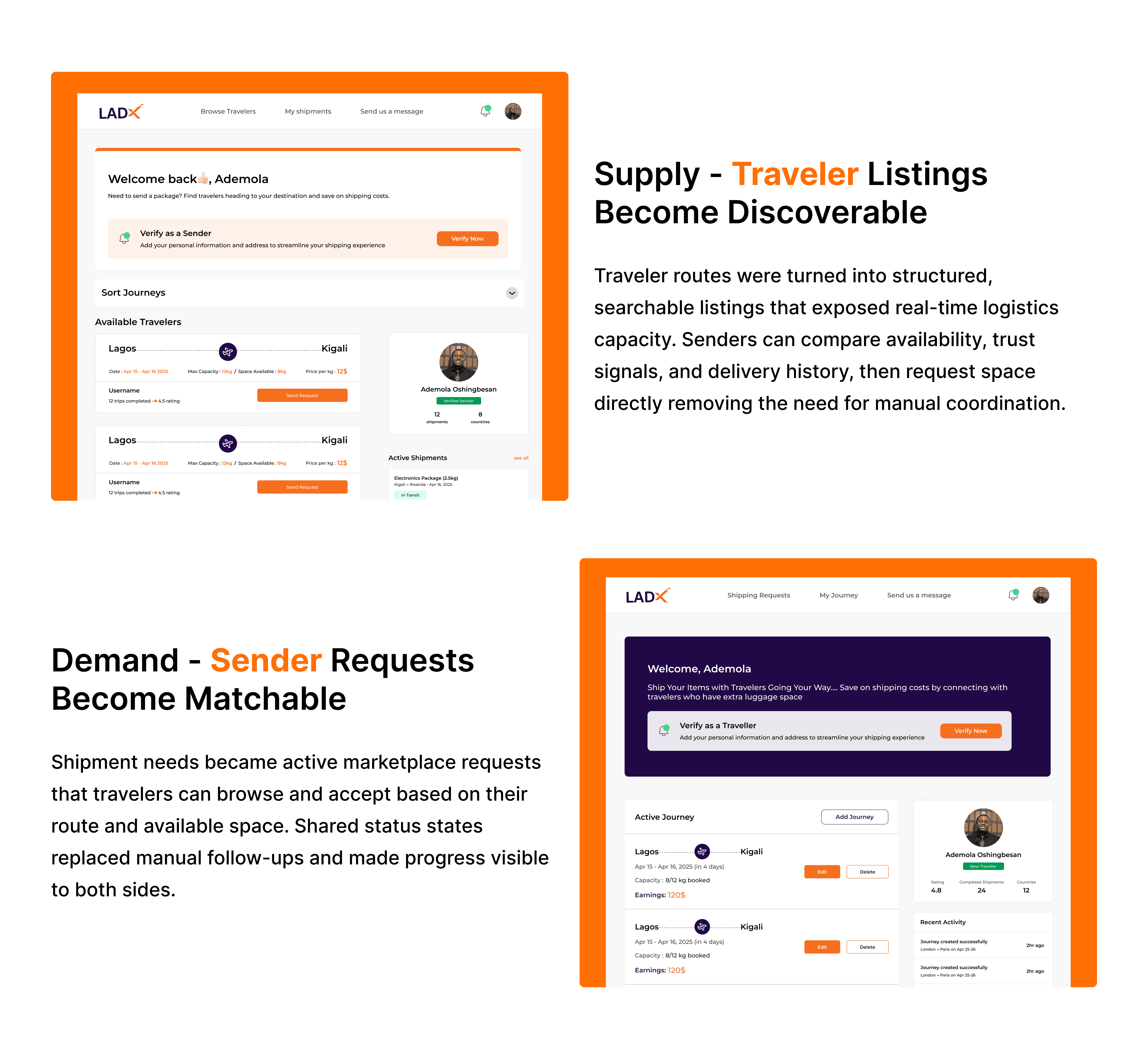
To move LadX beyond a concierge-style operation, We designed a lightweight marketplace MVP that transformed static submissions into structured supply and demand.
The goal was not simply to replace WhatsApp and Google Forms but to remove founders from the critical path of every transaction and allow the system to operate independently and at scale.
Our product strategy was simple: turn isolated requests into structured marketplace supply.
Previously, every submission existed as a separate record that founders had to manually review, interpret, and match. There was no live system connecting travelers and senders.
With the MVP, each request became a structured and discoverable listing. This created a real-time view of available routes and shipment needs, allowing users to find and match with each other directly through the platform instead of relying on the founders to coordinate everything.
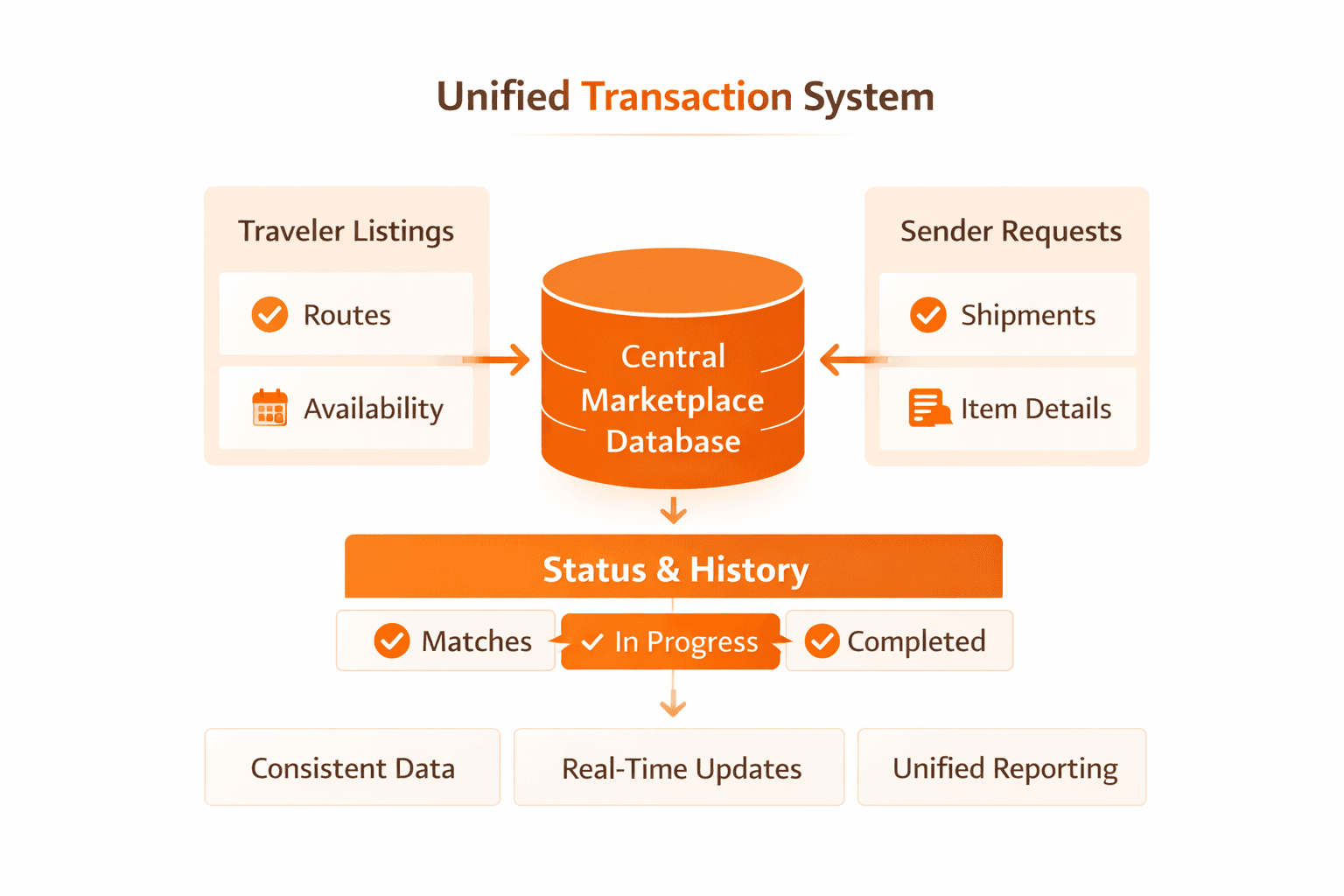
To support this shift, the platform introduced a unified system where every transaction lived in one place.
Travelers were represented as available logistics capacity, while senders created shipment requests that generated demand. Each interaction updated the same shared marketplace dataset, making activity across the platform visible in real time.
This meant matching no longer relied on message history or someone’s memory. Instead, every action generated structured data that could be used to monitor performance and guide future product decisions.
Designing the Marketplace Around Three Roles
Instead of designing a single linear flow, the platform was structured around three interconnected roles that support how the marketplace operates.
Travelers publish their routes and available luggage space, creating verifiable logistics capacity.
Senders create shipment requests, generating demand that travelers can browse and match with based on their routes.
Admins oversee the system by verifying activity, resolving disputes, and maintaining operational trust across the platform.
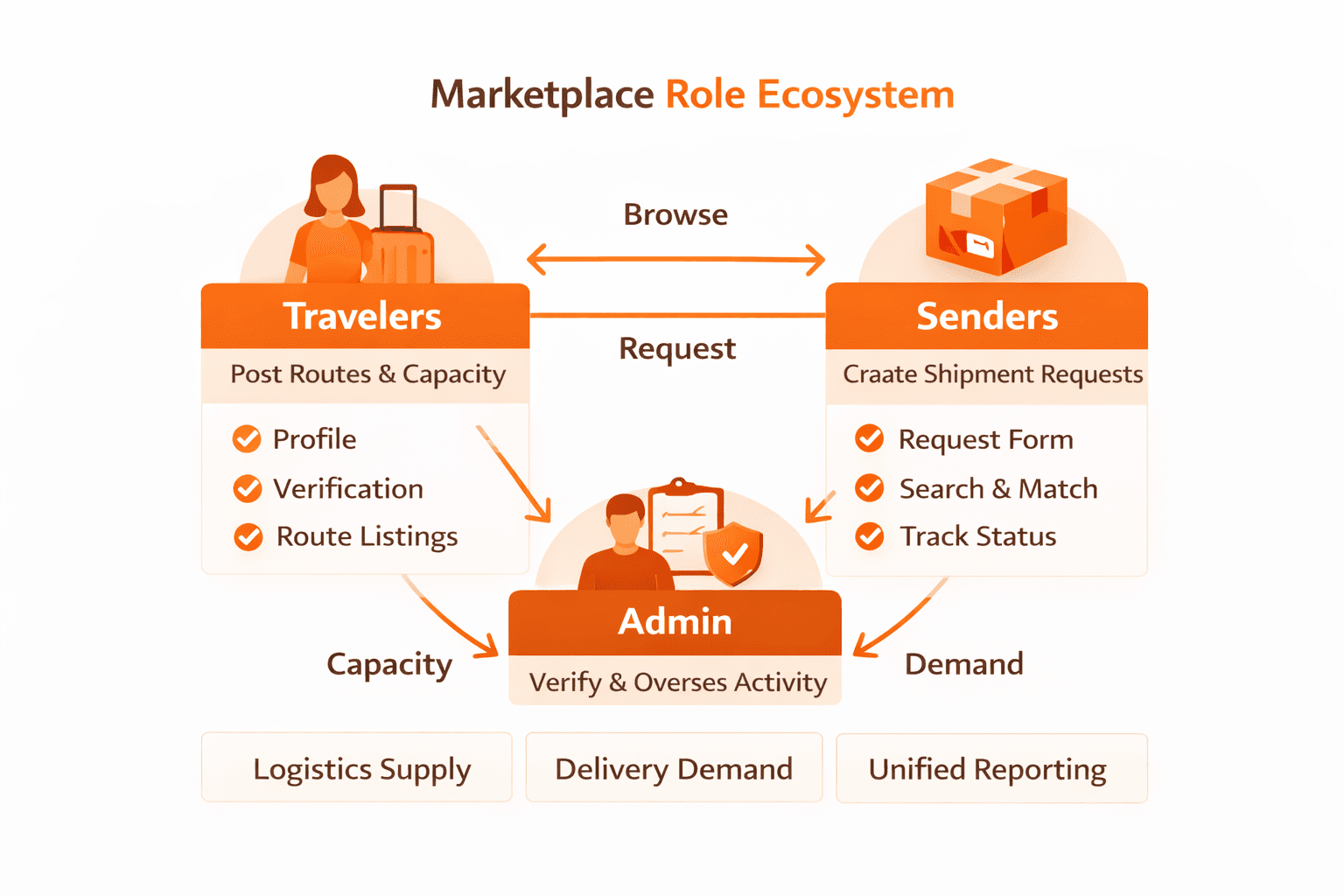
Separating the platform into these roles allowed the marketplace to scale without increasing coordination overhead, while also ensuring accountability between participants.
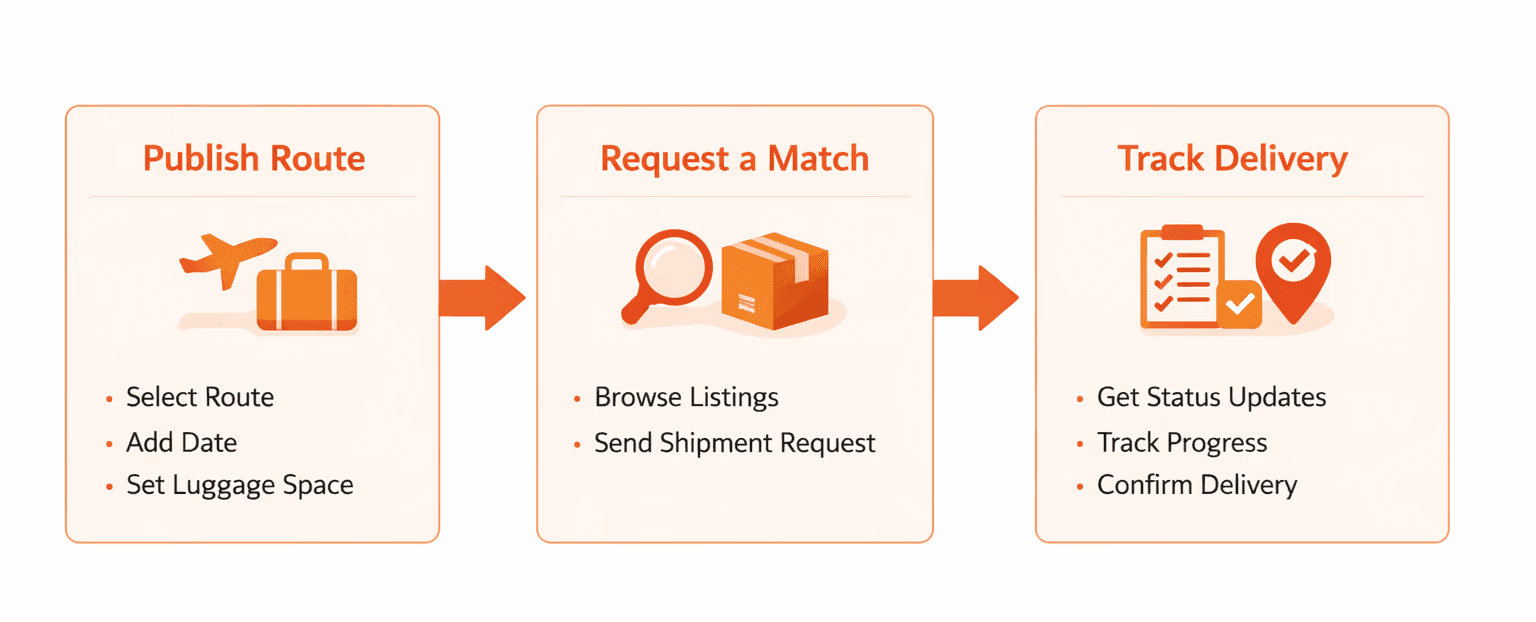
Enabling Self-Serve Matching
The goal of the experience was to move users away from conversation-based coordination and toward simple, structured marketplace actions.
Travelers publish a route with their available luggage space.
Senders browse those routes and request a match.
Both sides then track the delivery through shared status updates.
By turning these interactions into clear product flows, the platform reduced message volume, shortened matching time, and made the entire process more predictable and repeatable.
Building Trust Through System Feedback
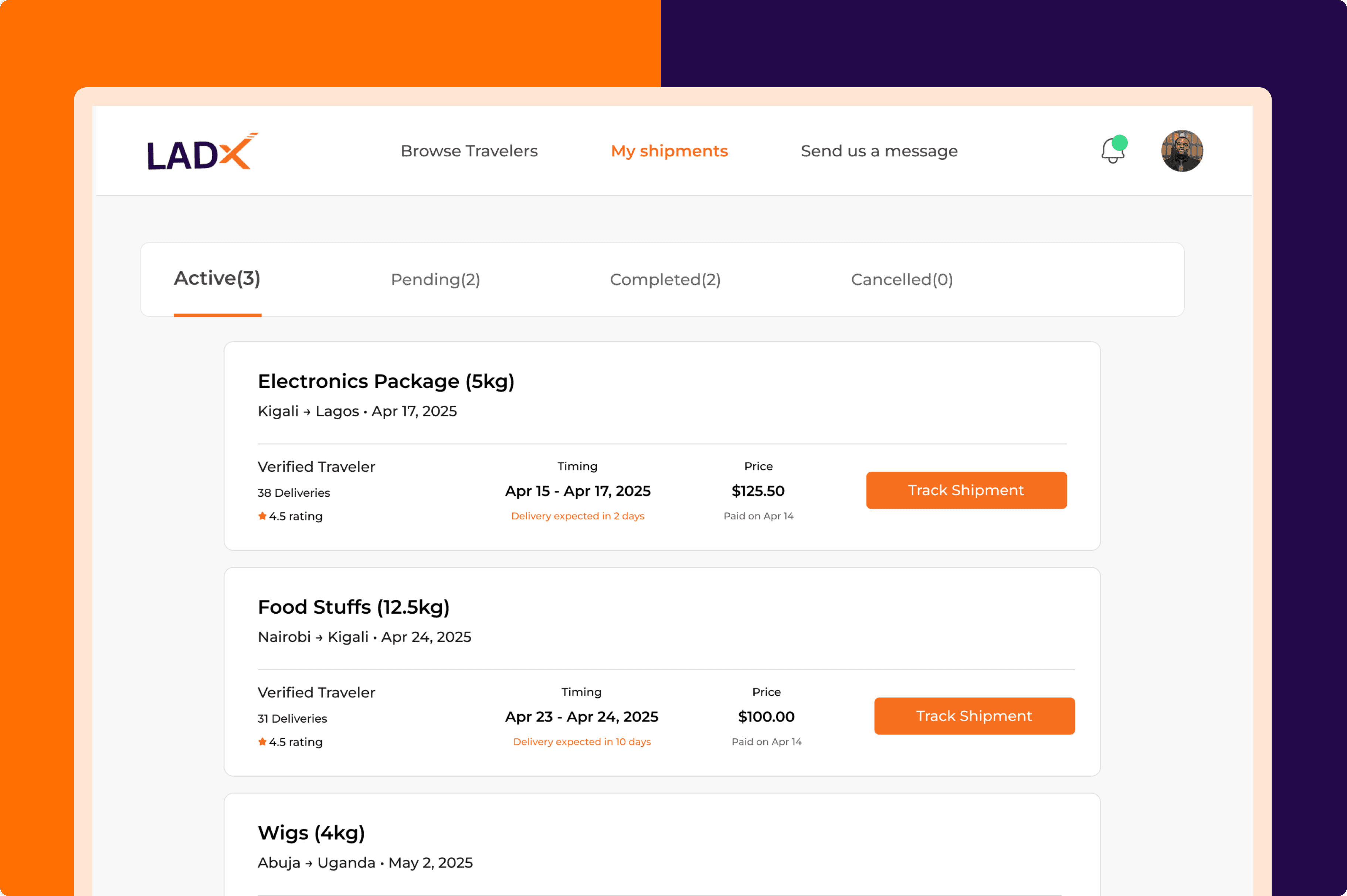
In the manual workflow, trust depended heavily on the founders being present in every interaction. They reassured both travelers and senders, confirmed details, and provided updates throughout the delivery process.
In the MVP, that responsibility shifted to the product itself. Trust was embedded directly into the interface through clear status updates, verified traveler profiles and routes, and consistent transaction records.
Instead of repeatedly asking for updates, users could simply follow the delivery progress through the platform.
Giving the Team Real-Time Operational Visibility
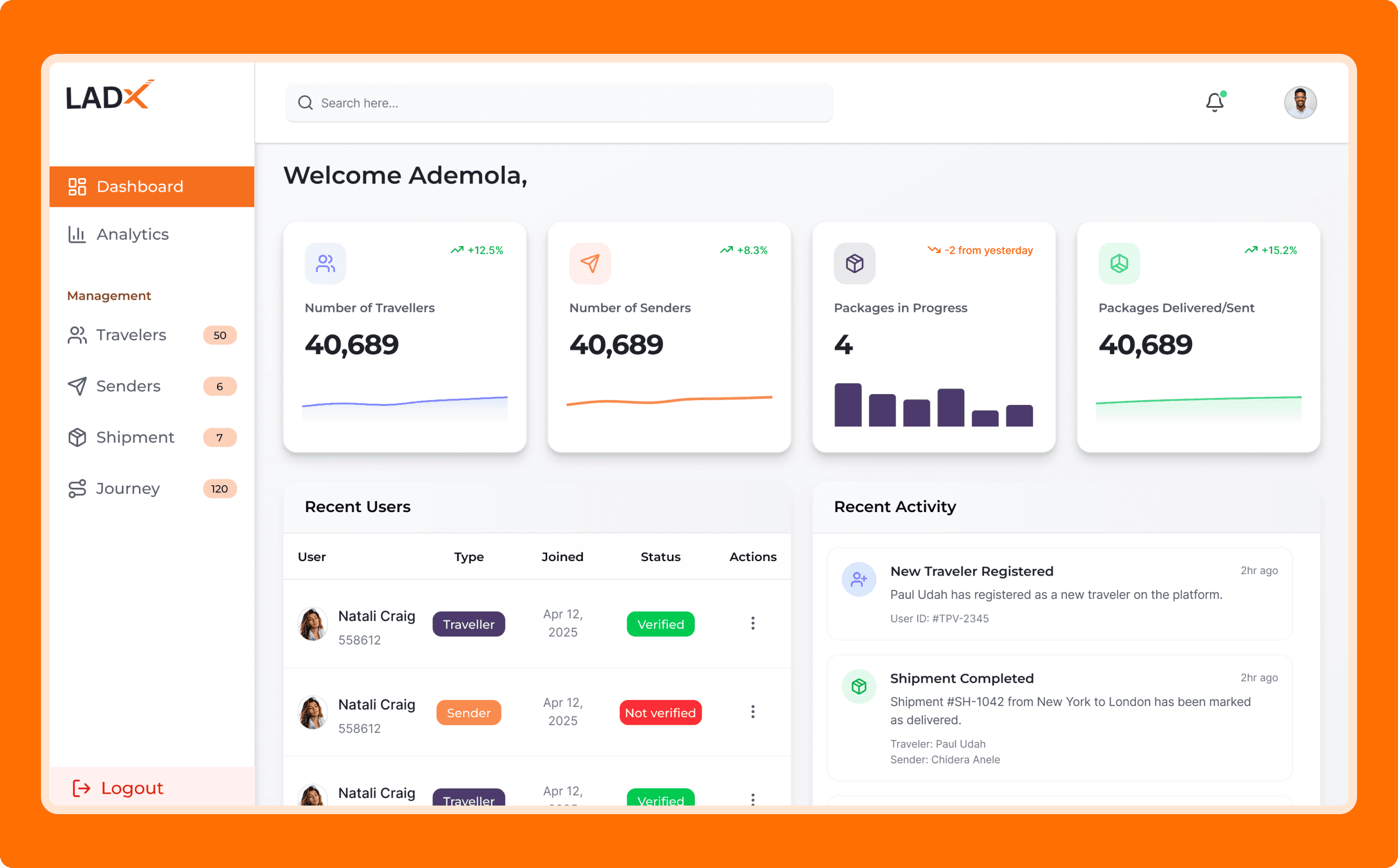
Beyond the user-facing experience, the MVP also captured structured operational and behavioral data automatically.
This allowed the team to monitor marketplace activity in real time, identify operational bottlenecks, and understand how the marketplace was performing as it grew.
Rather than coordinating every delivery manually, the admin layer became a lightweight control system that provided visibility and oversight across the platform.
The admin layer became a lightweight control system rather than a manual coordination tool.
Outcomes & Impact
What Changed Once the MVP Went Live
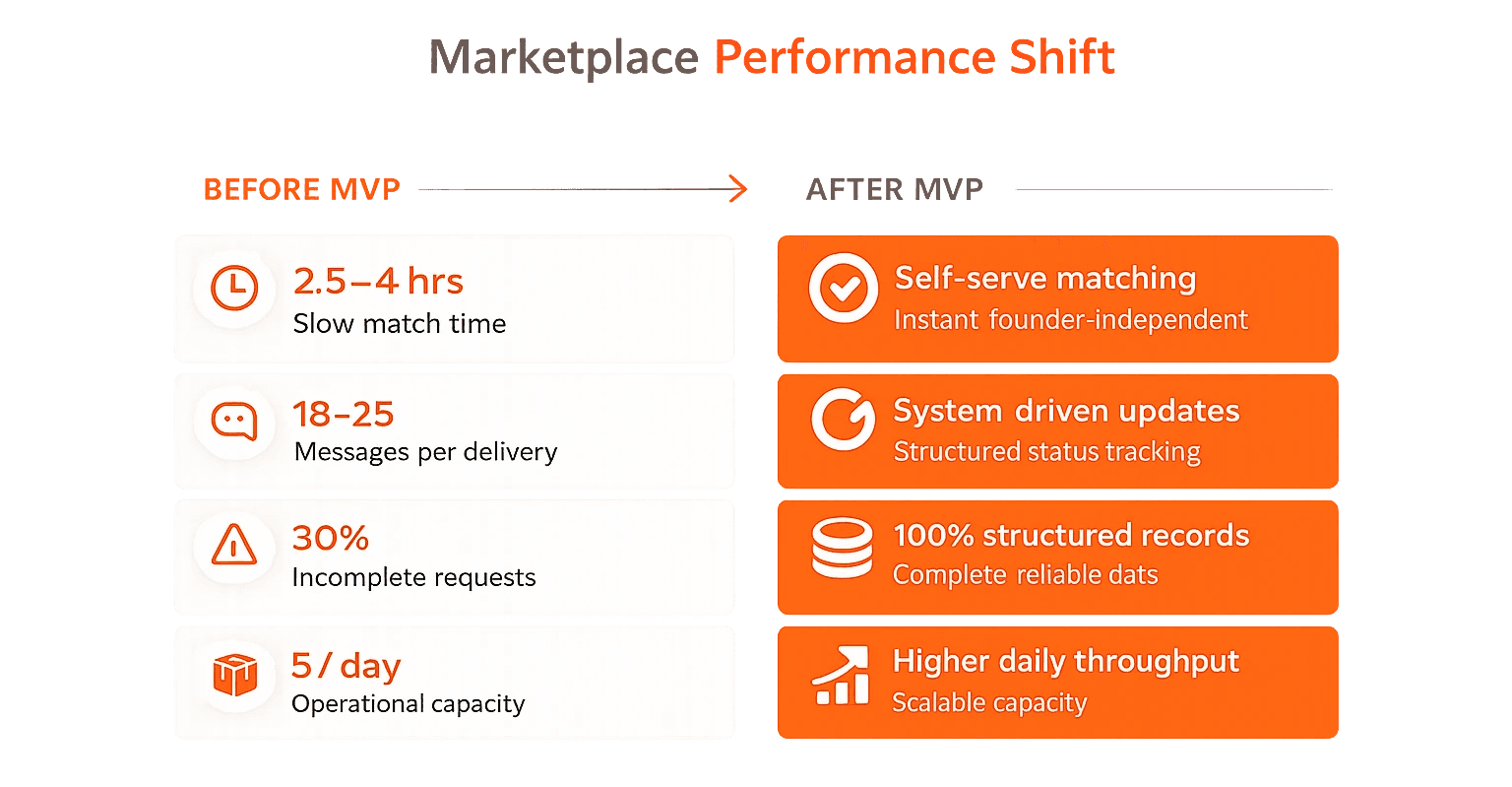
With the MVP in place, LadX moved from a manually coordinated service to a self-serve marketplace where travelers and senders could interact in real time. Matching no longer depended on founders interpreting messages, and deliveries progressed through shared status updates instead of ad-hoc follow-ups.
Operationally, this reduced coordination overhead, increased the number of shipments that could be handled each day, and introduced a consistent, trackable delivery flow.
Most importantly, the MVP validated the core idea behind LadX: Travelers were willing to publish their routes, Senders could independently discover those routes, and deliveries could be completed entirely within the platform.
Reflections & What Comes Next
Designing the first version of a two-sided marketplace meant finding the right balance between structure and familiarity.
Adding too much complexity too early could have slowed adoption, while copying the flexibility of WhatsApp too closely would have preserved the operational bottlenecks we were trying to eliminate.
The goal was to introduce just enough structure to support reliable matching and tracking, while keeping the experience simple enough for users to adopt quickly.
Looking ahead, the next phase of the product will focus on improving marketplace liquidity and trust through:
Smarter route recommendations
Pricing guidance and transaction safeguards
Stronger reputation and verification systems
Real-time delivery notifications
These improvements will help LadX move beyond MVP validation and continue evolving into a scalable logistics network.
Check Out the Live Product